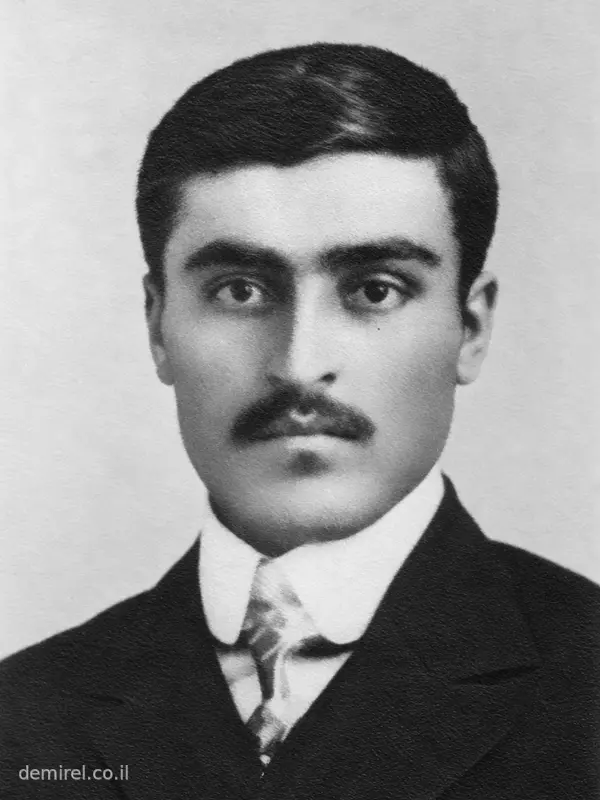
Avraham Demirel, known within his family also as Ibrahim, was Sinior Demirel’s elder brother and one of the prominent figures in the diary’s account of family life in Kohna Shahr during the First World War. The surname Demirel is used here to identify the family, although it was adopted only at a later date.
Early life and family
Avraham was probably born in Kohna Shahr, in the Salmas region, in the late 1880s or early 1890s. His date of birth is not recorded; this estimate is based on the fact that by 1918 he was already a married adult with experience in trade and travel to Russia.
His father was David, son of Yitzhak, and his mother was Daha Baji. His brothers included Sinior Demirel and Shimon, also called Shaban. Avraham was married to Biyaz, whose name means “white,” and they had a son named Rahmi, or Rahamim Demirel, who was still an infant during the events described in the diary. Rahamim later became the father of Gabriel Demirel.
Trade and connections with Russia
The diary indicates that Avraham was engaged in trade and had travelled to Russia. He spoke Russian fluently, a skill that helped him in his dealings with Russian soldiers operating in the Salmas region.
He is portrayed as a resourceful man of some means. At the time of his death, his possessions included a gold watch, a gold chain, ten gurush coins, money, and a ledger recording his debtors—evidence of his commercial activity and regional connections.
Defending his family and community
The diary portrays Avraham as a brave and resolute man who did not hesitate to confront armed men in defence of his family and neighbours. On a winter night in 1918, a group of armed Kurds attempted to force the family to host them. Avraham shut the door and prevented his father from opening it, even after the men threatened to break into the house.
When Russian soldiers attempted to break into and loot the family shop, Avraham confronted them with a pistol. He returned their fire and demanded that they leave not only his shop but the entire neighbourhood. His fluent Russian helped persuade the soldiers to withdraw.
Avraham and his brothers were also known to Simko Shikak. Members of the family had made boots for the Kurdish leader on two occasions, and he had been pleased with their work. This acquaintance helped the family after a confrontation with Simko’s men, and Simko subsequently ordered his followers not to enter the Jewish homes in the town.
Death in Tabriz
Following the destruction, massacres, and flight from Kohna Shahr, the family became dispersed. During a period when epidemics and disease struck refugees and local residents severely, Avraham reached Tabriz. The diary does not identify his illness, but he appears to have died there in 1918 or shortly thereafter.
Before his death, Avraham met Nizam, a close friend from a wealthy family in Kohna Shahr. Realising that he was gravely ill, Avraham entrusted him with his money and valuables and asked him to find his mother. If she was no longer alive, the property was to be given to another surviving relative.
Nizam faithfully safeguarded the deposit. After locating the family, he gave Avraham’s mother a bundle containing a gold watch, a gold chain, ten gurush coins, his debtors’ ledger, and 250 silver tomans. Nizam said that Avraham had been more than a friend to him and that he had loved him like a brother.
Burial
Because of the difficult circumstances, Avraham was initially buried at a temporary location in Tabriz. His brother Shimon later came to the city on a trading journey, located the grave, purchased a permanent burial plot, and transferred his brother’s remains there.
The plot Shimon purchased was larger than required for a single grave. He transferred its title documents to Jewish families from Urmia who had settled in Tabriz, so that the land could also serve as a Jewish cemetery.
Avraham in Sinior’s diary
Although Avraham’s life ended at a young age, the diary creates a clear portrait of him: an experienced and well-connected merchant, a fluent Russian speaker, a courageous family man, and a person with a deep sense of responsibility. He defended his home and neighbourhood during the collapse of public order and continued to provide for his family even in his final moments. His story reflects the precarious lives of the Jews of Salmas during war, displacement, and epidemic disease.
Names and spelling variants
Avraham; Ibrahim; elder brother Avraham; Avraham Demirel; Ibrahim Demirel
Mentioned in the book
Chapter One – Salmas; segment 01.05 – Uninvited Guests; Chapter Two – Refugees and Captives; segment 02.06 – My Brothers and Sisters, Avraham and Shmuel; Chapter Three – Wanderings; segment 03.02 – Khoy
Research note
An editorial note in the source states that Avraham was also called Ibrahim. His date of birth is unknown; the estimate that he was born in the late 1880s or early 1890s is based on his estimated age and family status in 1918. The diary likewise does not state the exact year of his death, although the sequence of events points to 1918 or shortly thereafter. The surname Demirel is used here to identify the family; it was adopted later and was not in use during the events described.