Summary
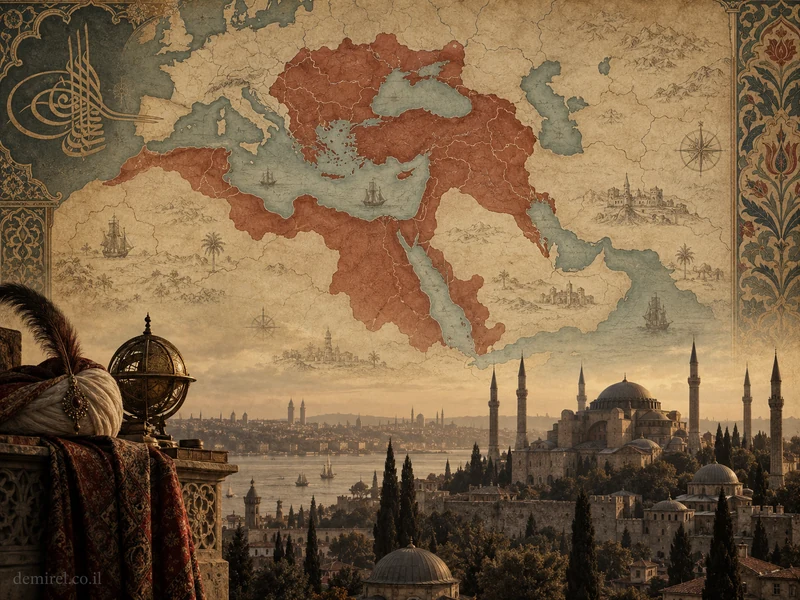
The Ottoman Empire (Ottoman Turkish: Memâlik-i Mahrûse-i Osmâniyye – “The Well-Protected Domains of the House of Osman”) was a multinational Islamic empire founded in the late 13th century that lasted for over six hundred years, until its official abolition in 1922. At its peak, during the 16th and 17th centuries, the empire spanned three continents: Southeastern Europe, Western Asia, and North Africa, serving as a major world power and a key geopolitical force.
History: Growth and Expansion (1299–1683)
The empire was established around 1299 by Osman I, a leader of the Turkmen tribes in Anatolia (modern-day Turkey). In 1453, Sultan Mehmed II conquered Constantinople, bringing an end to the Byzantine Empire and establishing the city as the new Ottoman capital (known as Istanbul).
Under the reign of Sultan Suleiman the Magnificent (ruled 1520–1566), the empire reached the zenith of its political, military, and cultural power. Its domain encompassed most of Central and Southeastern Europe (the Balkans and Hungary), the Middle East, and large parts of North Africa.
History: Decline and Reforms (1683–1908)
Following the failed Siege of Vienna in 1683, the empire entered a period of gradual decline, driven by technological and economic lag compared to European powers, alongside the rise of nationalist movements within its territories (particularly in the Balkans).
In the 19th century, in an attempt to modernize and prevent total collapse, a series of comprehensive reforms known as the Tanzimat period (1839–1876) was enacted. These reforms included a reorganization of civil administration, the legal system, and the military, the introduction of equal rights for non-Muslim subjects, and the strengthening of central authority.
History: Collapse, Partition, and the Eastern Campaign (1908–1923)
In 1908, the Young Turk Revolution seized power. The empire entered World War I on the side of the Central Powers (Germany and Austria-Hungary). During the war, the empire fought fiercely on multiple fronts, including the Persian Campaign around Lake Urmia. Its defeat in the war led to the occupation and partition of its territories by the Allied powers. The Ottoman Sultanate was abolished in 1922, and in 1923, following the Treaty of Lausanne and the Turkish War of Independence, the Republic of Turkey was founded under the leadership of Mustafa Kemal Atatürk.
Ottoman Involvement in the Persian Border and Lake Urmia Region (1900–1923)
The region between Eastern Anatolia and Northwestern Persia (modern-day Iran), specifically the plains around Lake Urmia, served as a complex strategic arena where Ottoman, Persian, Russian, and British interests intersected alongside multi-ethnic local populations.
Territorial Incursions and Border Disputes (1900–1914)
In the early 20th century, the Ottoman Empire took advantage of the weakness of the Qajar dynasty in Persia to solidify its hold over the vaguely defined borderlands. Starting in 1905, Ottoman forces repeatedly crossed into Persian territory west of Lake Urmia, establishing military posts and levying taxes on Kurdish tribes and local populations. The Ottoman administration exploited tribal tensions and rising Kurdish nationalism to deploy irregular forces (such as the Hamidiye cavalry) to secure its interests in this remote region.
World War I and the Persian Campaign (1914–1918)
With the outbreak of World War I, despite the Qajar Kingdom declaring neutrality, the Lake Urmia area became a primary battleground between the Ottoman and Russian Empires:
- Ottoman Incursion: In late 1914 and early 1915, Ottoman units, supported by allied Kurdish tribes, invaded Northwestern Persia, capturing the cities of Urmia and Tabriz.
- Demographic Composition and Human Tragedy: The Urmia plain was home to a large Christian population (Assyrians and thousands of Armenians) alongside Muslim residents (Shia and Sunni). The regions surrounding Lake Urmia suffered from frequent shifts in the frontlines. Alternating retreats and conquests by Russian and Ottoman forces led to massacres, looting, and widespread famine. The Assyrian and Armenian populations suffered severe atrocities, partly connected to the broader persecution of Christian minorities across the Ottoman Empire (the Armenian and Assyrian Genocide).
- Events of 1918 and Withdrawal: Following the collapse of the Russian front due to the Bolshevik Revolution (1917), the Ottomans re-established control over the region in the summer of 1918, pushing back local Assyrian militias and recapturing Urmia. However, the overall defeat of the Ottoman Empire in late 1918 forced its troops to fully retreat from Persian territory.
Aftermath and Border Settlement (1918–1923)
In the post-war years, the expanse between Lake Urmia and the Turkish border remained in a state of turmoil and local conflict involving Kurdish insurgents (such as Simko Shikak). Following the conclusion of the Turkish War of Independence and the signing of the Treaty of Lausanne (1923), the modern boundaries of the Republic of Turkey were finalized. The Turkish-Iranian border stabilized largely along historical lines, marking the complete end of Ottoman military and administrative presence in Persia and confirming Lake Urmia as sovereign Iranian territory.
Governance and Administrative Structure
- The Sultan and Caliph: The Ottoman Sultan held absolute monarchical power and, from the 16th century onward, also held the title of Caliph (leader of the Muslim world).
- The Sublime Porte (Bāb-ı Ālī): The central government in Istanbul, housing the Grand Vizier (Prime Minister) and the Imperial Council.
- Administrative Divisions: The empire was divided into provinces, initially called Eyalets and later reorganized into Vilayets, which were further subdivided into Sanjaks and Kazas. Provinces were governed by appointed officials (Valis or Pashas).
Society and Religion
Ottoman society was highly diverse in both ethnic and religious terms:
- The Millet System: The Ottoman state managed non-Muslim populations through autonomous religious communities (such as the Greek Orthodox, Armenian, and Jewish Millets). Each “Millet” retained internal autonomy regarding religious practices, personal status laws, education, and judicial matters, in exchange for loyalty to the empire and payment of specific taxes (such as the Jizya tax).
- Status of the Jewish Community: Jews were classified as “Dhimmi” (protected subjects). Following the expulsion of Jews from Spain in 1492, the Ottoman Empire welcomed tens of thousands of Sephardic refugees, who contributed significantly to the empire’s economy, trade, and culture (particularly in cities like Istanbul, Thessaloniki, Safed, and Jerusalem).
Names and spelling variants
Ottoman Empire; Ottoman border
Mentioned in the book
Chapter One – Salmas; segment 01.01 – Salmas; Chapter Three – Wanderings; segment 03.01 – The Return to Kuhna Shahr; Chapter Three – Wanderings; segment 03.03 – Dilman; Chapter Four – Bashhalan; segment 04.05 – Mümtaz Bey