
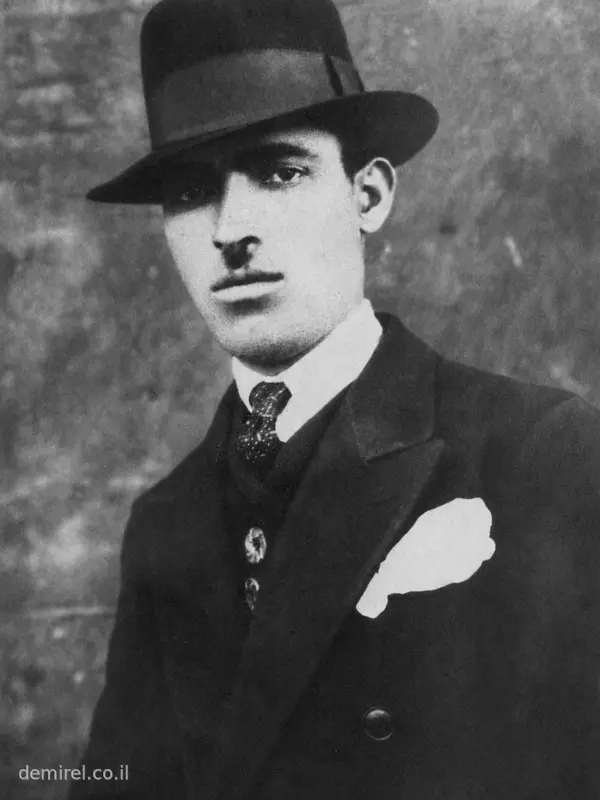
Sinior Demirel (1909–1987) was a Jew born in the Salmas region of northwestern Iran, a member of the community later known in Israel as “Nash Didan”, and the author of the diary at the center of this website. His memoirs trace his life from childhood in the Iran–Ottoman frontier region, through war, persecution, captivity and displacement, to his settlement in Başkale in eastern Turkey, his public activity and his service in the Turkish army. The diary is also an exceptional personal testimony to Jewish life in Salmas, Van and Başkale during the first half of the twentieth century.
Sinior himself described the manuscript as a testimony to events he had lived through and things he had seen. In the introduction, he wrote that he had managed to record only part of his life experiences and that he wrote them at the encouragement of his wife, whose support he acknowledged throughout his life.
Childhood in Salmas
Sinior was born in 1909 in Navahi-Sharqiya, in the Salmas region near the Turkish border. His family lived in Kuhna Shahr, where a small Jewish community of about seventy families lived alongside Muslim and Armenian residents. He describes a Jewish quarter with two synagogues, a school under the supervision of the community’s hakham, and active commercial life, but also a persistent sense of insecurity, robbery and violence against minorities.
His father was David, already about sixty years old during the events of the First World War and the head of the family. His mother was Daha-Baji. His siblings included Abraham, also called Ibrahim, Shimon, Hanna and Sultan, along with other relatives mentioned in the memoir. The family was badly affected by war, violence and epidemics; several of his brothers and sisters died during the years of displacement. Abraham, his elder brother, died of illness in Tabriz.
The First World War and the events in Salmas
Sinior’s childhood and youth unfolded in a region contested by Russian, Ottoman, Armenian, Assyrian, Kurdish and Iranian forces. Control changed hands repeatedly, and the Jewish community had to adapt to each new authority while trying to remain outside the conflicts.
The diary describes in detail the rise of Simko Shikak, the power struggles among Kurdish tribes, and their direct impact on the Jews. At times Kurdish fighters entered Jewish homes and remained there as forced “guests”, while families had to provide food and lodging for both the men and their horses.
One of the most important historical episodes described in the diary is the murder of the Assyrian patriarch Mar Benyamin Shimun by Simko and the Assyrian retaliation that followed. Sinior witnessed at close range events in which the Jewish community was also harmed. His family hid in their home when Assyrian forces entered Kuhna Shahr, and afterward Sinior was held captive for a period in the Khosrova area.
His testimony later drew the attention of researchers of Assyrian history, in part because it adds a Jewish perspective on the murder of Mar Shimun and the events that followed. A researcher associated with the Mar Shimun Foundation noted that Sinior’s account fits alongside other eyewitness testimony while adding details absent from those sources.
A refugee, a captive, and a son of a shattered family
The postwar years were marked by repeated displacement. Family members moved between Kuhna Shahr, Khosrova, Dilman, Khoy and other places. Violence, looting, disease and epidemics reduced both the family and the community around them.
Sinior describes not only major historical events but also their impact on his own family: the death of his father, the deaths of siblings, loss of property, and the sense that the world in which he had grown up was falling apart. His memoir follows the attempt to return to Kuhna Shahr and rebuild life, and then the gradual decision to leave the area.
From Dilman to Van and Başkale
After the years of displacement, the family passed through Dilman and later Van. During this period Sinior began to rebuild an independent life.
On one of his brother’s journeys, the brother met a female relative who had just returned from Tiflis and decided to propose her as a bride for Sinior. In this way Sinior came to know Malka, daughter of Varda and Menachem and granddaughter of Hanuka. The wedding took place in the Van region after they waited for a hakham from Başkale to arrive and conduct the ceremony.
Malka became his life partner and later the mother of his children. Among them was David Demirel, who would later play a central role in translating his father’s diary and preparing the version on which the present project is based.
Eventually Sinior moved to Başkale, which became the center of his life during the later period described in the diary.
His standing in Başkale
In Başkale, Sinior’s social position changed markedly. The child who had once been forced to hide and wander became a recognized local figure with connections to government officials, military officers and community leaders.
The diary portrays him repeatedly as an intermediary between the Jewish community and the authorities. He helped Jews with documents, residence status and dealings with government offices, and intervened when necessary in public disputes.
According to his account, in a local election in Başkale Sinior received the highest number of votes, but was not permitted to take office because he was a non-Muslim. Even so, he was included in local public mechanisms and served, among other things, on a committee dealing with Turkey’s Wealth Tax, a levy imposed on property owners that in practice hit minority communities particularly hard.
The Jewish community of Başkale was by then only a remnant of a much larger community. Sinior states that before the First World War the town had been home to hundreds of Jewish, Armenian and Kurdish families, whereas in his own time only a few dozen Jewish families remained. Most of the shops still operating in the town were nevertheless owned by Jews.
Activity on behalf of the community
In several episodes described in the diary, Sinior acted directly to protect Jews.
When an accusation was being fabricated against members of the community, he used his relationship with the kaymakam to prevent escalation. He then preferred reconciliation with the other side rather than prolonging the confrontation.
In another case, he helped three displaced Jewish families, former Ottoman subjects who had been left without papers, regularize their stay in Turkey. He also describes a sharp confrontation with the official Mümtaz Bey while trying to assist them.
When a group of discharged soldiers refused to leave and the situation threatened to turn violent, Sinior joined the local mufti in an effort to calm them.
Another major episode was the trial of Shmuel “Shmil” Kutler. Sinior traveled first to Van and then to Ankara to advance the appeal in his case. In Ankara he relied on a judge he knew from Başkale and on Dr. Osman, and after Shmuel’s release he continued on to Istanbul.
Military service
A substantial part of the diary is devoted to Sinior’s service in the Turkish army. At first he was able to make use of his skill as a tailor, a trade in which he was experienced, and was assigned duties accordingly.
Later, his technical and practical abilities also became evident. He was given responsibility for construction and engineering work and supervised teams of soldiers. On one occasion he personally selected thirty soldiers, organized them as a work crew, and led the construction of a large wooden bridge. The work drew praise from senior officers, and the colonel who came to inspect the bridge granted him a month’s leave in recognition.
These chapters reveal a trait that runs throughout his memoirs: an ability to adapt quickly to new situations, establish relationships with very different people, and find practical solutions even under difficult conditions.
Author of the diary
Sinior did not write an academic history but a personal memoir. Some of the events took place when he was a child, others when he was an adult and an active participant in public life. He wrote about them years later, sometimes from direct memory and sometimes by incorporating things he had heard from others.
The uniqueness of the diary lies precisely in this point of view. It presents regional history not through state institutions or armies, but through the life of a Jew who lived between Iran and Turkey and knew Kurds, Assyrians, Armenians, Turks, Iranians and government officials at close range. Alongside major historical events, the diary records details about synagogues, trade, weddings, neighborhood relations, communal customs, military service and everyday life.
Late in life, Sinior sought to preserve at least part of these memories. He died in 1987. The manuscript he left behind is the testimony on which The Diary of Sinior Demirel is based.
Names and spelling variants
Sinior; Sinior Demirel
Mentioned in the book
Chapter One – Salmas; segments 01.01–01.07; Chapter Three – Wanderings; segment 03.01 – The Return to Kuhna Shahr; Chapter Three – Wanderings; segment 03.03 – Dilman; Chapter Four – Bashhalan; segment 04.01 – Bashhalan; segment 04.02 – The End of Simko; segment 04.03 – The Wealth Tax; segment 04.04 – The Accusation; segment 04.05 – Mümtaz Bey; segment 04.06 – Shmuel’s Trial; segment 04.07 – Osman of the Merziki Tribe; segment 04.08 – Smuggling the Frontier; Chapter Five – Military Service; segment 05.01 – Military Service; Chapter Five – Military Service; segment 05.02 – Siirt; Chapter Five – Military Service; segment 05.03 – The Camp Tailor; Chapter Five – Military Service; segment 05.04 – A Second Call-Up; Chapter Five – Military Service; segment 05.05 – The Unit Engineer; Chapter Five – Military Service; segment 05.06 – Bridges; Chapter Six – Epilogue; segment 06.01 – Epilogue
Research note
The surname Demirel is used here to identify the family. It was adopted at a later date and was not in use during the period in which the events described took place.