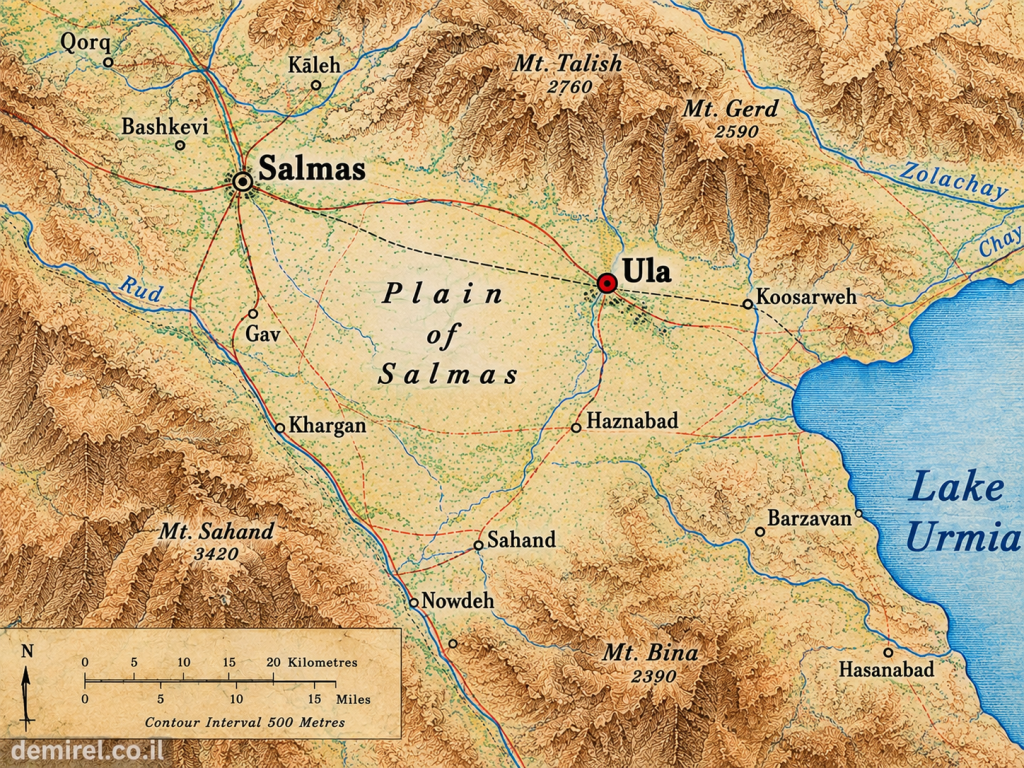
Ula (also written Ola) is a village in the Salmas region of northwestern Iran, mentioned in the diary of Sinior Demirel in connection with the Assyrian population and the turbulent events in the region after the First World War. The precise modern identification of the village and the exact spelling of its name still require further research, so the historical testimony should be distinguished from the later geographical identification.
Ula in the Salmas region
Ula belonged to the rural landscape of Salmas, an area where Muslim, Armenian, and Assyrian Christian communities lived alongside one another. Other important settlements on the Salmas plain included Haftavan, Khosrowa, and Patawar. Haftavan, one of the major centers of the plain, is also documented archaeologically as a site with a very long history; during the Sasanian period it had a population that the archaeologist Charles Burney interpreted as a non-Iranian and non-Christian community, apparently Armenian.
The Assyrian-Chaldean community
Ula stands out in the Christian sources for Salmas. In lists of Chaldean communities from 1913, Ula appears as a village with 400 believers, two priests, and one church. Sources describing the ecclesiastical history of the region note that at an earlier period many inhabitants of Ula were loyal to the patriarchs of Qudshanis, and that during the nineteenth century the village was known among supporters of the East Syriac tradition for preserving that tradition faithfully.
Ula and the multi-community population
Ula should not be viewed as an isolated Christian village. It was part of a plain in which different communities lived alongside one another, and during the nineteenth and early twentieth centuries their relations changed as a result of migration, changes of government, missionary activity, local tensions, and wars. The existence of a church alongside a larger Muslim population in some sources reflects the demographic complexity of the region.
The First World War and displacement
The First World War transformed the settlement and community map of the Salmas region. The displacement of the Assyrian population from Hakkari brought refugees to villages on the Salmas plain, including Ula, Khosrowa, Gulozan, Patawar, and Haftavan. During this period the region became an arena of conflict involving Ottoman, Russian, Iranian, Kurdish, and Assyrian forces, and local communities suffered from violence and displacement.
Ula in Sinior’s diary
Ula is mentioned in Sinior Demirel’s diary in two different contexts. In segment 01.04 – “The Assyrians and the Kurdish Fraternal Conflict”, it is listed among the villages to which Assyrians came after their displacement from Hakkari in 1915, alongside Khosrowa, Gulozan, Patawar, and Haftavan. The segment describes the concentration of the displaced people in these villages and the violent situation that developed in the region as a result of conflicts among Kurdish leaders and the rise of Simko’s power. In segment 03.01 – “The Return to Kuhna Shahr”, Ula appears again in a personal context: Sinior’s brother, Shaban, rescued two Ajami captives from their captors and, after freeing them, escorted them until they reached Ula safely. The two references place Ula within the network of villages through which Jews, Assyrians, Kurds, and Armenians moved during the turbulent period after the First World War, giving the village a tangible place in Sinior’s personal memory.
Modern identification
The precise identification of historical Ula with a present-day settlement requires caution. Different spellings of the name exist, and modern sources also use the name Owlaq (اولق) in the Salmas area. At this stage, it is appropriate to present the connection as a research identification that still requires verification, rather than as an established fact.
Sources
- Sinior Demirel’s diary, Chapter One – Salmas, segment 01.04 – “The Assyrians and the Kurdish Fraternal Conflict”.
- Sinior Demirel’s diary, Chapter Three – Wanderings, segment 03.01 – “The Return to Kuhna Shahr”.
- Charles Burney, “Haftavān Tepe”, Encyclopaedia Iranica.
- Chaldean Catholic Eparchy of Salmas – lists of Chaldean communities in the Salmas region in 1913.
Research note
The spelling and modern identification of Ula still require verification through contemporary maps and geographical sources. Ula as it appears in Sinior’s testimony should be distinguished from the modern identification of the place-name.