Summary
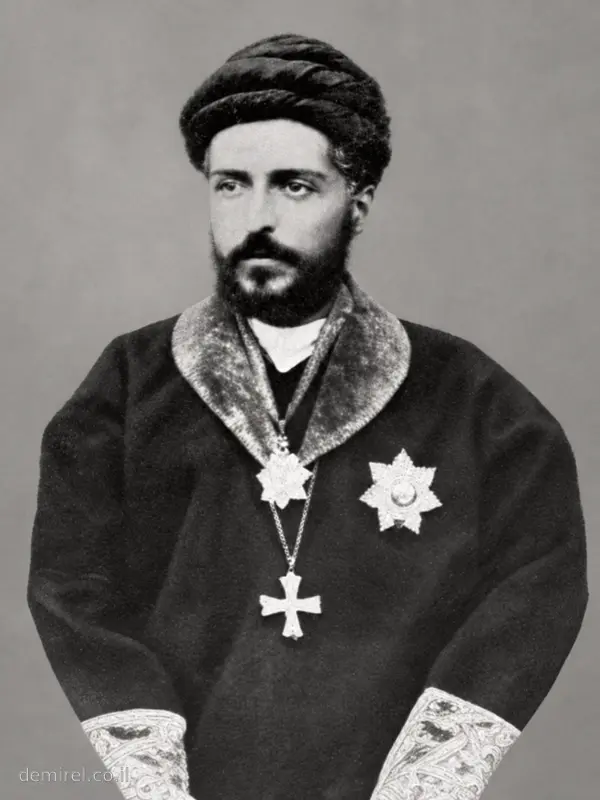
Mar Benyamin Shimun (1887–1918) was Catholicos-Patriarch of the Church of the East from 1903 until 1918 and the religious and communal leader of the Assyrians during one of the most turbulent periods in their modern history. Born in Qudshanis in the Hakkari region of the Ottoman Empire, he was assassinated in 1918 in an ambush organised by Simko Shikak and his men following a meeting at Kuhnashahr in Salmas.
Early life and accession to the patriarchate
Benyamin was born in Qudshanis in 1887 into the d’Mar Shimun family, whose members had occupied the patriarchal throne for generations. His father, Eshai, was a brother of Patriarch Mar Rowil Shimun. After his father’s death in 1895, Benyamin, his sister Surma and other potential heirs were placed under the care of their uncle.
In addition to his traditional religious education, Benyamin and Surma received private instruction from the Anglican missionary William Henry Browne. Benyamin studied English and other subjects under Browne. In March 1903, at about sixteen years of age, he was ordained metropolitan by his uncle. Following Mar Rowil’s death later that month, Benyamin was consecrated Catholicos-Patriarch.
At the time, succession to the patriarchal throne followed a hereditary tradition in which the office normally passed from uncle to nephew. Benyamin’s accession at such a young age initially faced opposition from rivals within the community and from other ecclesiastical interests, but his authority was eventually accepted by most of the communities subject to the patriarchal see.
Religious and national leadership
Mar Shimun’s role was not limited to the Church. Within the social organisation of the Assyrian tribes of Hakkari, the patriarch exercised communal, political and judicial authority. He represented the communities before the Ottoman government, mediated disputes and maintained difficult relations with Kurdish tribal leaders, foreign powers and competing missionary organisations.
His patriarchate coincided with the weakening of Ottoman authority in the region, rivalry among Russia, Britain and the Ottoman Empire, and growing conflict between local communities. During the First World War, the Assyrians were drawn into a struggle for survival. Their massacres and forced displacement formed part of the events later remembered as Seyfo, the Assyrian genocide.
In 1915 the Ottoman authorities detained Mar Benyamin’s brother Hormizd and used him as a hostage in an attempt to compel the patriarch to surrender the Assyrian tribes. Mar Benyamin refused to sacrifice his people in order to save his brother, and Hormizd was publicly executed in Mosul. In Assyrian memory, this decision became a defining example of personal sacrifice for the nation.
Displacement from Hakkari and refuge in Persia
During the fighting, Mar Benyamin and much of his community were forced to abandon their villages in Hakkari and cross the mountains into the Urmia and Salmas regions of Persia. He worked to organise the refugees, obtain food and medical assistance, and build a force capable of defending the displaced communities.
Mar Benyamin sought Russian support and travelled to Tiflis to meet Grand Duke Nicholas. Assyrian forces fought alongside Russian troops for a time. The patriarch was awarded the Order of Saint Anna, while Assyrian fighters received Saint George medals through him. The Russian withdrawal following the Revolution of 1917, however, left the Assyrians without the military protection upon which they had relied.
Mar Benyamin subsequently established his residence in Khosrowa. Sinyor Demirel’s diary describes him as assisting the poor and the refugees and distributing allowances to Muslims, Jews and Christians without distinction. This local testimony adds an important civilian and humanitarian dimension to his better-known ecclesiastical and military roles.
The meeting with Simko and the assassination
In early 1918, efforts were made to establish cooperation between the Assyrians and the Kurdish forces of Ismail Agha Shikak, better known as Simko. In the context of plans for an anti-Ottoman alliance, Simko invited Mar Benyamin to meet him at Kuhnashahr in the Salmas district.
Although members of his family and others warned him of the danger, Mar Benyamin travelled to the meeting accompanied by approximately 150 armed horsemen. According to the surviving accounts, Simko received him with honour and the two discussed peace and cooperation. As the patriarch and his party prepared to leave, Simko’s men opened fire from the roofs, windows and surrounding streets. Mar Benyamin and many of his attendants were killed. His brother, Rab Khaila Dawid d’Mar Shimun, escaped and took refuge in an Armenian church.
The accepted Gregorian date of the assassination is 16 March 1918, corresponding to 3 March in the Julian calendar used by some contemporary sources. Different accounts occasionally give a different date or weekday. Sinyor Demirel’s diary preserves local testimony placing the shooting on a Friday afternoon. The diary’s version should therefore be retained as an independent historical testimony alongside the generally accepted chronology.
Mar Benyamin’s body was recovered by Assyrian fighters. His murder triggered a campaign of retaliation against Simko and his supporters and greatly intensified the violence in the region. Muslim and Jewish civilians were also caught in the conflict, detained or removed from their homes. Mar Benyamin’s brother, Mar Poulos Shimun, was consecrated patriarch shortly afterwards.
Mar Benyamin Shimun in Sinyor’s diary
Mar Benyamin is one of the central historical figures in Sinyor Demirel’s diary. Sinyor describes the patriarch’s residence in Khosrowa, his assistance to the poor and to members of different faiths, his assassination, and the violence that followed. The diary also preserves local testimony concerning the ambush and the conduct of Assyrian forces in its immediate aftermath.
The historical value of this material was recognised by researchers associated with the Mar Shimun Memorial Foundation. In correspondence with Michael Demirel, Christopher Nelson explained that extracts from the diary had been placed alongside other eyewitness accounts in the Foundation’s historical timeline. He particularly noted the diary’s unusual importance as a source for the actions of Assyrian forces and the experiences of local residents following the assassination.
Legacy
Mar Benyamin is remembered among Assyrians as a leader and martyr who guided his people through war, destruction and displacement. The Assyrian Church of the East commemorates him annually, and his life remains a symbol of religious devotion, national leadership and sacrifice for the community.
Sources
- Mar Shimun Memorial Foundation, “Mar Benyamin Shimun”.
- Mar Shimun Memorial Foundation, The History of the Patriarchal Succession of the d’Mar Shimun Family, updated edition.
- Yaşar Kaplan, “The Last Period of the Nestorian Patriarchy in Hakkâri (1876–1915)”, Milel ve Nihal 17(2), 2020.
- Assyrian Church of the East, “Celebrating the Future: Honouring a Sacrifice”, 2024.
- Sinyor Demirel’s Diary, Chapter One: “The Assyrians and the Kurdish Fraternal Conflict” and “The Death of Mar Shimun”; Chapter Four: “The End of Simko.”
- Correspondence of Michael Demirel with Christopher Nelson and Arbella d’Mar Shimun, 2020 and 2026.