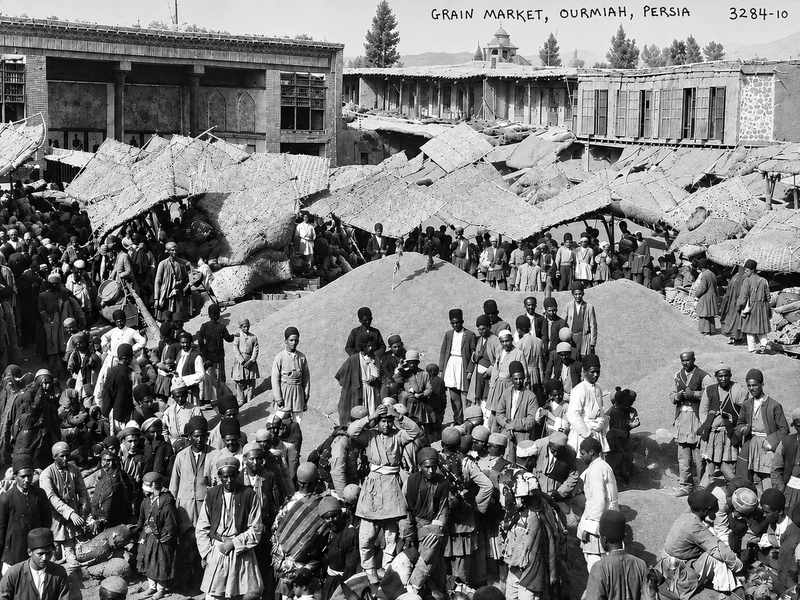
Urmia (also spelled Urmiya; Persian: ارومیه), known during part of the twentieth century as Rezaiyeh, is a city in northwestern Iran and the capital of West Azerbaijan Province. It lies west of Lake Urmia, near the border with Turkey. Its location at the intersection of Iran, Anatolia, Kurdistan, and Mesopotamia gave it considerable commercial and strategic importance throughout history. The region was ethnically and religiously diverse, and its population included Muslims, Armenians, Assyrians, and Jews. Within this setting, a Jewish community existed in Urmia for many centuries and became one of the important Jewish communities of northwestern Iran.
Origins of the Jewish Community
Jewish communal tradition attributes the beginnings of Jewish settlement in the region to the Assyrian exile and to the exiles from the Kingdom of Israel. This tradition was an important element of the historical identity of the Jews of the region. However, there is no continuous historical documentation demonstrating an uninterrupted Jewish settlement in Urmia from antiquity through the modern period. More generally, Jewish presence in western and northwestern Persia is documented from antiquity and forms part of the broader history of Iranian Jewry. Encyclopaedia Iranica
In the Middle Ages, Urmia was also associated with David Alroy, the twelfth-century Jewish messianic leader who operated in the region. More detailed information about the Jewish community in Urmia becomes available in the early modern period, particularly from the nineteenth century onward. In 1828, the Jewish traveler David D’Beth Hillel visited Urmia and reported three synagogues. His account reflects an organized community, but also the difficult circumstances experienced by Jews in the region, including discrimination, poverty, and persecution.
The Community in the Nineteenth Century
During the nineteenth century, Urmia was home to a substantial Jewish community whose life was shaped by the political and social conditions of Qajar Iran. Jews in the region were periodically subjected to discrimination and violence and, at times, faced severe economic hardship. The famine that affected northwestern Iran in the early 1870s was among the major crises that affected the community.
Despite these difficulties, the community maintained its religious and social institutions. Jews lived in defined areas of the city, maintained synagogues and communal institutions, and engaged in a variety of commercial and artisanal occupations. Communal life developed within a multilingual environment in which Persian, Azerbaijani, Kurdish, and Aramaic were spoken.
Urmia at the Beginning of the Twentieth Century
At the beginning of the twentieth century, Urmia was one of the major Jewish centers of Iran. According to data collected by the Alliance Israélite Universelle for 1903/4, approximately 2,200 Jews lived in Urmia. This placed the city among the more significant Jewish communities of Iran, alongside communities in Tehran, Isfahan, Hamadan, Shiraz, Kermanshah, and Yazd. Encyclopaedia Iranica
Urmia’s Jews were engaged in commerce and a variety of crafts and occupations, including textile trading, jewelry, money changing, and itinerant trade. The community maintained connections with Jewish centers elsewhere in the region, and families moved between different settlements for commercial, economic, and marriage-related reasons.
Language and Identity: The Nash Didan
In linguistic and cultural terms, the Jews of Urmia belonged to the wider group of Jewish communities that spoke Neo-Aramaic languages in northwestern Iran and eastern Anatolia. Members of these communities referred to themselves as Nash Didan—”our people” or “our own people”—and to their language as Lishan Didan, “our language.” Lishan Didan was a Jewish Neo-Aramaic variety that developed in and around the Urmia region and was influenced by the languages of the surrounding population, particularly Azerbaijani and Kurdish.
Lishan Didan was not merely a language of everyday communication but an important component of communal identity. It was used within families and in daily life, alongside Hebrew as the language of religious tradition and alongside Persian and other local languages. Linguistic research distinguishes the Jewish Neo-Aramaic varieties of the region from the Christian Neo-Aramaic varieties spoken by Assyrians and notes the strong influence of the surrounding Turkic-speaking environment on the Jewish dialect of Urmia. Jewish Languages
Connections with Salmas and Başkale
The Jewish community of Urmia formed part of a broader Jewish cultural area extending across the modern Iranian-Turkish border. In particular, it maintained close connections with the Jews of Salmas in northwestern Iran and with the Jews of Başkale in eastern Turkey. The communities shared religious and linguistic traditions and maintained family, commercial, and migratory connections. Research by Nesi Altaras on the Jews of the Van–Urmia region emphasizes that, until the First World War, the area constituted a cross-border Jewish environment in which family, commercial, and religious ties extended across the frontier between Iran and the Ottoman Empire. For the Jews of the region, including speakers of Lishan Didan, the area between Lakes Van and Urmia functioned as an interconnected communal network rather than as a collection of isolated communities. National Library of Israel; Nesi Altaras, The Jews of Van-Urmia
World War I
World War I was a decisive turning point in the history of the Jews of Urmia and the other Jewish communities of the region. Warfare in northwestern Iran and eastern Anatolia, together with intercommunal violence and political upheaval, resulted in widespread displacement and migration. Jews, Assyrians, and Armenians in the region were all affected by the violence and insecurity, and substantial numbers of inhabitants were forced to leave their homes.
The war also disrupted the network of connections that had linked the Jewish communities on both sides of the border for generations. According to Altaras, approximately 2,000 Aramaic-speaking Jews lived in the area between Lakes Van and Urmia on the eve of World War I, many of them belonging to the Nash Didan communities. The war effectively brought an end to the region’s significant cross-border Jewish network, although smaller Jewish communities continued to exist in parts of the area for several decades. Altaras, 2023
The Community in the Twentieth Century and Migration to Israel
Following World War I, a Jewish community continued to exist in Urmia, but its population gradually declined. Political and social changes in Iran, urbanization and modernization, and migration to other cities all contributed to changes in the traditional structure of the community.
The establishment of the State of Israel in 1948 accelerated Jewish emigration from Iran. Jews from Urmia and the surrounding region gradually migrated to Israel, and during the 1950s and subsequent decades the Jewish population of the city declined substantially. Members of the Nash Didan who settled in Israel continued, to varying degrees, to preserve their language, customs, and memories of their communities of origin.
The Heritage of the Jews of Urmia
The heritage of the Jews of Urmia is an important part of the history of Iranian Jewry, as well as of the history of Jewish communities in the borderlands between Iran, Turkey, and Kurdistan. The distinctive character of the community derived from the combination of its place within Iranian Jewish society and its close connections with the Aramaic-speaking Jewish communities across the border.
The Lishan Didan language, prayer traditions, customs, family memories, and surnames preserve evidence of a social world that largely disappeared during the twentieth century. Today, many descendants of the Jews of Urmia live in Israel and in other countries, where elements of the cultural and linguistic heritage of northwestern Iranian Jewry continue to be preserved.
Historical Significance
The history of the Jews of Urmia reflects the distinctive character of northwestern Iran, a region in which political boundaries changed repeatedly while social, commercial, familial, and linguistic connections endured for generations. The Jewish community was an integral part of the city’s multiethnic and multireligious character, and its heritage represents an important chapter in both the history of Iranian Jewry and the history of the Nash Didan.
The memory of Urmia’s Jewish community is preserved today primarily among former members of the community and their descendants in Israel and elsewhere. Through family traditions, historical documentation, and linguistic and genealogical research, substantial aspects of this community’s history can still be reconstructed, providing a record of one of the distinctive Jewish societies that developed in the region between Iran, Anatolia, and Kurdistan.
Sources
- Houman M. Sarshar, “Judeo-Persian Communities of Iran: i. Introduction”, Encyclopaedia Iranica.
- Houman M. Sarshar, “Judeo-Persian Communities: v. Qajar Period”, Encyclopaedia Iranica.
- Nesi Altaras, “The Jews of Van-Urmia: Remembering Borderland Migrations (1914–18)”, Jewish Social Studies, vol. 28, no. 1, 2023, pp. 79–115.
- Geoffrey Khan, The Jewish Neo-Aramaic Dialect of Urmi, Piscataway, NJ: Gorgias Press.
- Jewish Languages, “Jewish Neo-Aramaic”.
- National Library of Israel, bibliographic record for Nesi Altaras, “The Jews of Van-Urmia: Remembering Borderland Migrations (1914–18)”.
Names and spelling variants
Urmia; Urmi; Urumia
Mentioned in the book
Chapter One – Salmas; segment 01.04 – The Assyrians and the Kurdish Fraternal Conflict; Chapter Three – Wanderings; segment 03.03 – Dilman; Chapter Four – Bashhalan; segment 04.08 – Smuggling the Frontier