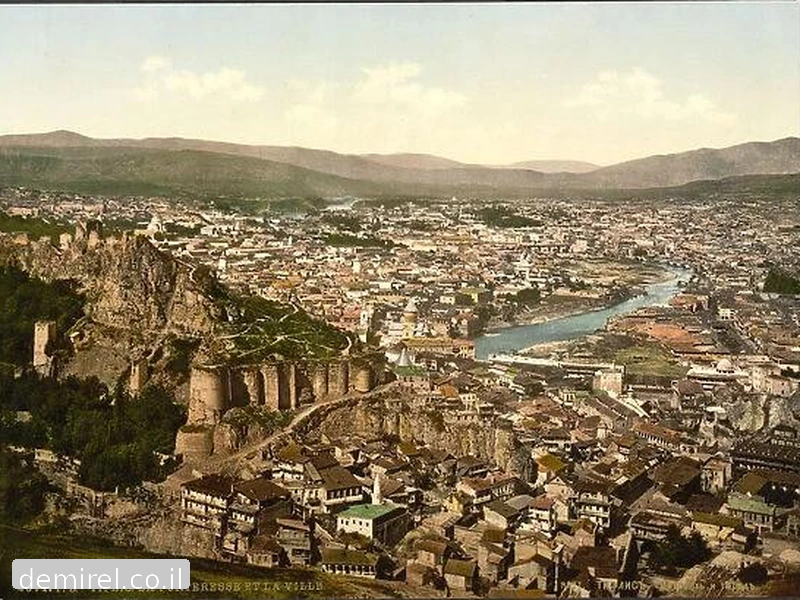
Tiflis, now Tbilisi, is the capital and largest city of Georgia. It lies in eastern Georgia, in the valley of the Kura River, at a crossroads linking Europe and Asia and the Black Sea and Caspian regions. Its strategic location has made it an important political, commercial, and cultural center of the Caucasus for centuries.
The Origins of Tiflis
The city has ancient origins, and according to Georgian tradition its development is associated with the area’s warm springs. In the sixth century, Tiflis became the capital of the kingdom of Kartli and gradually established itself as an important political center of eastern Georgia.
Its strategic position exposed the city to repeated struggles between regional powers. Tiflis was conquered and damaged during numerous campaigns, including those of Persian, Byzantine, and Arab forces, yet the urban center was rebuilt repeatedly.
Tiflis in the Middle Ages
During the Middle Ages, Tiflis was one of the important centers of the Caucasus. Following the Arab conquest in the eighth century, the city became the center of the Emirate of Tiflis. In later centuries, local rulers and regional powers repeatedly contested control of the city.
In the twelfth century, during the Georgian kingdom’s Golden Age, Tiflis gained in importance and became one of the kingdom’s principal centers. The city’s expanding trade attracted people from different ethnic and religious communities and contributed to its diverse character.
A Multicultural City
Tiflis’s position on major trade routes gradually made it a city where different communities lived alongside one another. Georgians, Armenians, Persians, Russians, Muslims, Jews, and others participated in the city’s commercial and cultural life.
This historic urban fabric can still be seen in the old city of Tbilisi, where Christian churches, synagogues, mosques, bathhouses, and buildings from different periods stand close to one another. This combination is one of the defining features of the historic city.
The Jewish Community of Tiflis
The Jewish community was part of the human fabric of Tiflis for centuries. Historical sources indicate a Jewish presence in the region from ancient times, and in the sixth century Jews from Mtskheta came to Tiflis. Over the centuries they were joined by Jews from other regions, including Persia and Russia. During the nineteenth century the community grew significantly, and by the end of that century the city was home to several Jewish groups, including Georgian Jews and Ashkenazi Jews. Tiflis also became one of the centers of Zionist activity in the Caucasus in the late nineteenth and early twentieth centuries.
Tiflis under Russian Rule
Russian influence in Georgia strengthened toward the end of the eighteenth century, and in 1801 the kingdom of Kartli-Kakheti was annexed to the Russian Empire. Tiflis became the principal administrative center of Russian rule in the Caucasus.
During the nineteenth century the city expanded rapidly. Trade, crafts, industry, education, and cultural institutions developed, and Tiflis became a center attracting residents and merchants from throughout the Caucasus and beyond. This period contributed greatly to the city’s cosmopolitan character.
From Tiflis to Tbilisi
During the twentieth century the city continued to serve as Georgia’s political and cultural center. In the Soviet period, Tbilisi was the capital of the Georgian Soviet Socialist Republic. After Georgia declared independence in 1991, it became the capital of the independent state.
The historical name Tiflis remains in use in many languages, while Tbilisi is the Georgian and official name used today.
Tbilisi Today
Today Tbilisi is the political, economic, academic, and cultural center of Georgia. Alongside modern neighborhoods and new construction, many historic areas have survived, including the old city, the fortress, the bathhouses, and religious buildings belonging to different communities.
The city’s long history, its location at the heart of the Caucasus, and the continuing encounter between peoples, religions, and cultures make Tbilisi one of the key cities for understanding the history of Georgia and the region as a whole.
Names and spelling variants
Tiflis (Tbilisi); Tiflis; Tbilisi
Mentioned in the book
Chapter One – Salmas; segment 01.01 – Salmas