
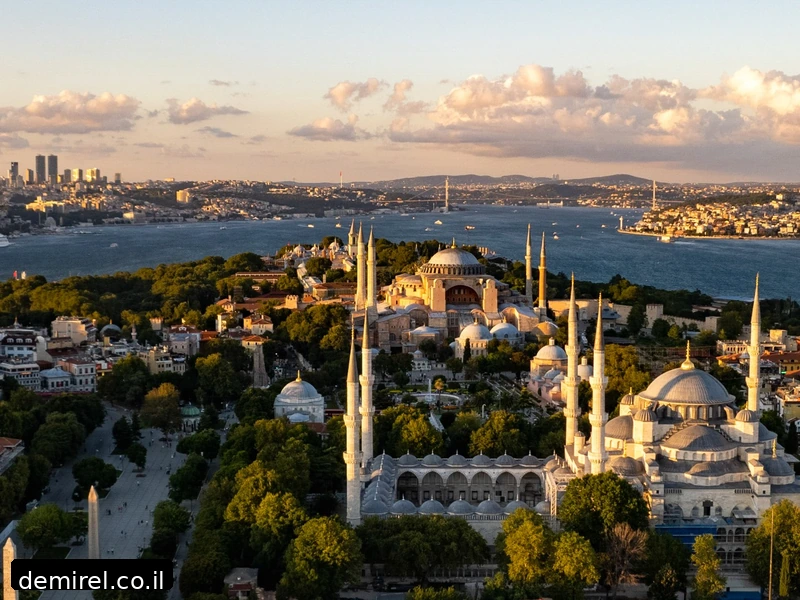
Istanbul (Turkish: İstanbul) is the largest city in Turkey and one of the most historically significant cities in the world. Straddling the Bosporus Strait, which separates Europe from Asia, it is the only major city located on two continents. With a population of more than 15 million people, Istanbul serves as Turkey’s principal economic, cultural, and commercial center. Throughout its long history, the city has been known as Byzantium and Constantinople, serving as the capital of the Byzantine and Ottoman Empires before becoming the country’s leading metropolis in the modern era.
Geography and Location
Situated in northwestern Turkey, Istanbul occupies both the European and Asian shores of the Bosporus. Its strategic location between the Black Sea and the Mediterranean has made it a vital crossroads for trade, migration, and cultural exchange for more than two millennia.
History
Byzantium
The city was founded in the 7th century BCE by Greek settlers from Megara and was known as Byzantium. Thanks to its favorable position along major trade routes, it quickly developed into an important commercial center.
Constantinople
In 330 CE, Emperor Constantine I designated the city as the capital of the Eastern Roman Empire. Renamed Constantinople, it became one of the most influential political, religious, and cultural centers of the Christian world and remained the capital of the Byzantine Empire for over a thousand years.
The Ottoman Era
In 1453, Sultan Mehmed II conquered Constantinople, ending the Byzantine Empire and establishing Ottoman rule. The city became the capital of the Ottoman Empire and flourished as one of the world’s great imperial capitals. During this period, many of Istanbul’s most famous mosques, palaces, and public buildings were constructed.
Modern Period
After the establishment of the Republic of Turkey in 1923, the national capital was moved to Ankara. Nevertheless, Istanbul remained the country’s largest city and continues to be its primary center of finance, culture, tourism, and international commerce.
The Jewish Community of Istanbul
Early Jewish Presence
Jewish communities existed in the region long before the Ottoman conquest. Among the earliest were the Romaniote Jews, a Greek-speaking Jewish population that had lived within the Byzantine Empire for centuries.
Sephardic Settlement
A major turning point occurred after the expulsion of Jews from Spain in 1492. Ottoman Sultan Bayezid II welcomed thousands of Jewish refugees from Spain and Portugal, many of whom settled in Constantinople. Their arrival transformed the city’s Jewish community and helped establish Istanbul as one of the leading centers of Sephardic Jewish life.
A Center of Jewish Life
For centuries, Istanbul was home to numerous synagogues, rabbinical academies, charitable institutions, and Hebrew printing presses. Ladino, the Judeo-Spanish language of the Sephardic Jews, became widely spoken, while Jewish merchants, physicians, scholars, and craftsmen played important roles in the economic and cultural life of the Ottoman Empire.
The Community Today
Although many Turkish Jews emigrated during the twentieth century, particularly after the establishment of the State of Israel, Istanbul remains the center of Jewish life in Turkey. The city is home to active synagogues, schools, cultural institutions, and community organizations that continue to preserve a rich Sephardic and Ottoman Jewish heritage.
Legacy and Significance
For more than 2,500 years, Istanbul has served as a bridge between civilizations, religions, and continents. Its unique combination of Byzantine, Ottoman, Turkish, and Jewish heritage makes it one of the world’s most important historical and cultural cities.
Names and spelling variants
Istanbul; İstanbul; איסטנבול
Mentioned in the book
Chapter Four – Bashhalan; segment 04.06 – Shmuel’s Trial; Chapter Five – Military Service; segment 05.04 – A Second Call-Up; Chapter Five – Military Service; segment 05.05 – The Unit Engineer; Chapter Five – Military Service; segment 05.06 – Bridges