
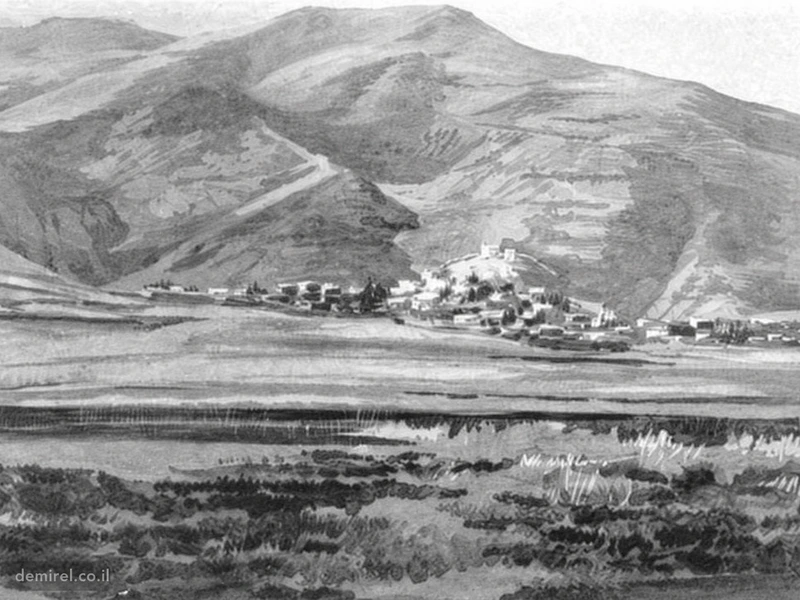
Bashkale (Turkish: Başkale; in the local Aramaic dialect: Bashhalan) is a town and district center in Van Province in eastern Turkey, near the Iranian border. It lies in a high mountainous region, at an elevation of approximately 2,460 meters, on a route that for generations connected Van, Hakkari, and northwestern Iran. Its location made it a regional transit point for trade, migration, and the movement of people between the Ottoman Empire and Persia.
History
The settlement was known at different times as Adamma, Adamakert, and Elbak. Over the course of its history, the region passed under the rule of Urartu, Persia, Byzantium, Armenian rulers, and local kingdoms. It was incorporated into the Ottoman Empire in the mid-sixteenth century, and by the late nineteenth century it was the center of the Elbak district in the Hakkari Sanjak of the Van Vilayet. During the Turkish Republic, its present name, Başkale, was adopted. Source: Başkale District Governorate.
The Jewish community
For generations, Bashkale was home to a Neo-Aramaic-speaking Jewish community that formed part of the cultural world of the Jews of Van and Urmia and of the community later known as Nash Didan. A study published in 2024 indicates that Jewish social, religious, and economic life existed there for at least two hundred years. The community spoke Aramaic as its principal language, alongside Kurdish and Turkish, and lived among the region’s Kurdish, Turkish, Armenian, and Yazidi populations. During the twentieth century, Jewish families gradually left Bashkale, and by the second half of the century no active Jewish community remained there. Source: Çelik and Levendoğlu, “Cultural Background of Van Başkale Jews”.
Bashkale in the diary
Bashkale occupies a central place in Sinyor Demirel’s diary: it was his family’s home and the setting for many of the events he recorded. His descriptions provide an inside account of Jewish life in the town, relations with neighboring communities, and the changing realities of the border region during the first half of the twentieth century.
Names and spelling variants
Bashkale; Başkale; Bashhalan (Aramaic); בשקלה; בשחלן
Mentioned in the book
Chapter Three – Wanderings; segment 03.03 – Dilman; Chapter Four – Bashhalan; segment 04.01 – Bashhalan; segment 04.02 – The End of Simko; segment 04.03 – The Wealth Tax; segment 04.04 – The Accusation; segment 04.05 – Mümtaz Bey; segment 04.06 – Shmuel’s Trial; segment 04.07 – Osman of the Merziki Tribe; segment 04.08 – Smuggling the Frontier; Chapter Five – Military Service; segment 05.01 – Military Service; Chapter Five – Military Service; segment 05.03 – The Camp Tailor; Chapter Five – Military Service; segment 05.04 – A Second Call-Up; Chapter Five – Military Service; segment 05.06 – Bridges; Chapter Six – Epilogue; segment 06.01 – Epilogue